
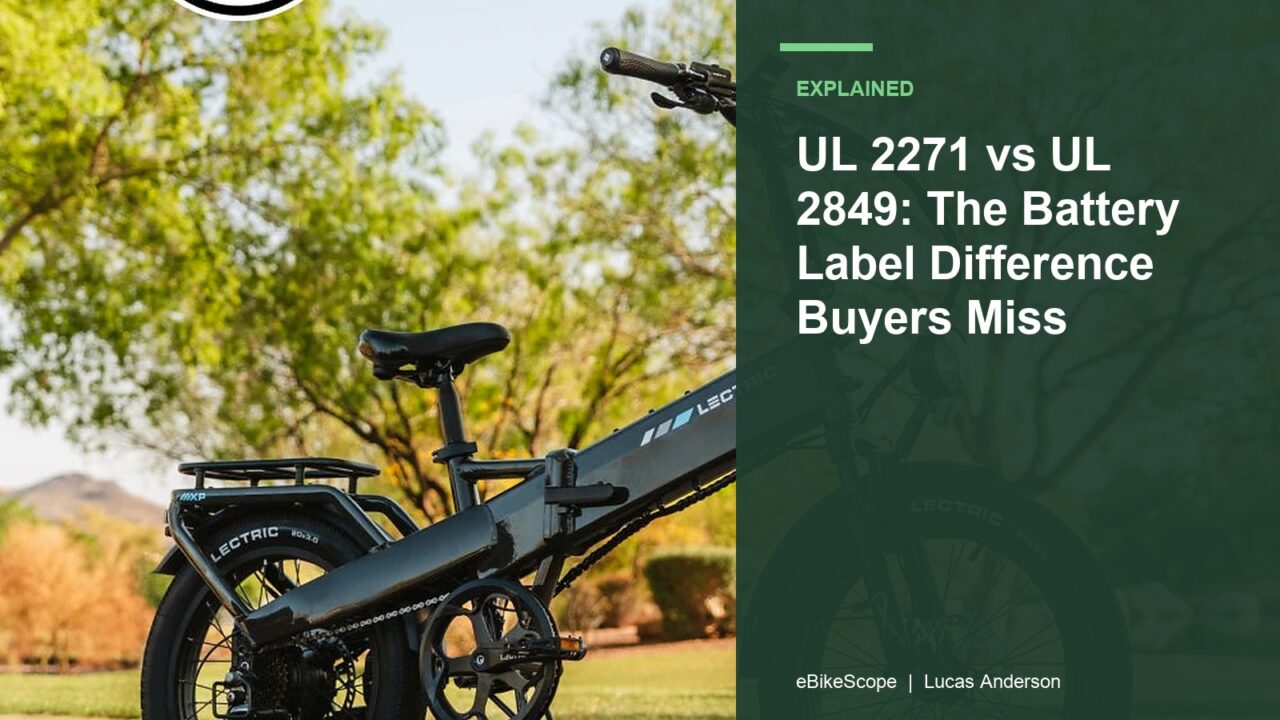
Understanding UL 2271 vs UL 2849 requires more than recognizing the label. Separate battery-pack certification from complete electrical-system certification and explain why charger compatibility still matters. That evidence belongs in the written UL 2271 vs UL 2849 comparison so a temporary price or display setting cannot quietly replace it.
This guide uses current manufacturer pages and public safety or access guidance for XP4 Tempest Grey eBike, Aventure 3 Ebike. It is a specification-based editorial analysis, not a claim that Lucas Anderson personally rode every product or recreated every scenario. In this UL 2271 vs UL 2849 guide, the point matters only when it changes a repeated trip, safety margin, or ownership task.
Prices, inventory, bundles, firmware, accessories, and policies can change. Confirm the exact frame and configuration on the seller's current page and save any written answer that affects compatibility, capacity, or coverage. For this UL 2271 vs UL 2849 decision, keep that result tied to the rider, route, and ownership conditions defined above.
Translate the label into a rider task
Terms such as torque sensor, Class 3, UL 2849, mid-drive, IP rating, or watt-hours are starting points. Compatibility, behavior, limits, and failure response complete the meaning. For buyers comparing certification claims, the key decision is this: Separate battery-pack certification from complete electrical-system certification and explain why charger compatibility still matters. Applied to UL 2271 vs UL 2849, this check should use the exact configuration and normal weekly conditions rather than a category assumption.
Jump to the decision point
- Turn the specification into a rider task
- Model year and part number matter
- Settings change feel, not physics
- A rating is a boundary, not a target
- Safety reserve belongs in the purchase
- Check the route owner and local rule
- Build a preventive maintenance rhythm
- Choose useful reserve over unused complexity
- Buyer questions
Current official model snapshot
| Model | Official price observed | Useful current-page details |
|---|---|---|
| XP4 Tempest Grey eBike | $999 | MSRP:999, pack-override-2, spinimages=36, tier1 bike pdp |
| Aventure 3 Ebike | $1,799 | 20 MPH, 26 Inch Tires, 28 MPH, 400lb Capacity |
Prices and configurations are a current source check, not a guaranteed future offer. The official page and checkout control the transaction. That evidence belongs in the written UL 2271 vs UL 2849 comparison so a temporary price or display setting cannot quietly replace it.
Turn the specification into a rider task
A shopper can make UL 2271 vs UL 2849 easier by writing the requirement before looking at another feature. For this article, the requirement follows directly from the buyer's situation: separate battery-pack certification from complete electrical-system certification and explain why charger compatibility still matters. The checkpoint in this section is turn the specification into a rider task. In this UL 2271 vs UL 2849 guide, the point matters only when it changes a repeated trip, safety margin, or ownership task.
Change one variable at a time and save the default. Test a new class mode, sensor response, app permission, pressure, or component in a low-risk place and keep a clear way to reverse it. Applied to turn the specification into a rider task, the implication is specific: Separate battery-pack certification from complete electrical-system certification and explain why charger compatibility still matters. For this UL 2271 vs UL 2849 decision, keep that result tied to the rider, route, and ownership conditions defined above.
For the turn the specification into a rider task checkpoint, XP4 Tempest Grey eBike is currently listed at $999 and its official source highlights MSRP:999, pack-override-2, spinimages=36, tier1 bike pdp; while Aventure 3 Ebike is currently listed at $1,799 and its official source highlights 20 MPH, 26 Inch Tires, 28 MPH, 400lb Capacity. Use the UL Solutions overview of UL 2849 e-bike system certification where its subject applies, then confirm narrower state, local, facility, or manufacturer instructions for the actual purchase. Applied to UL 2271 vs UL 2849, this check should use the exact configuration and normal weekly conditions rather than a category assumption.
Before ordering XP4 Tempest Grey eBike, Aventure 3 Ebike, ask the seller for a model-year-specific written answer whenever fit, capacity, compatibility, warranty, included hardware, or software behavior controls the purchase. Save the answer with the receipt because a general photograph is not a configuration promise. Use this procedure specifically for turn the specification into a rider task. That evidence belongs in the written UL 2271 vs UL 2849 comparison so a temporary price or display setting cannot quietly replace it.

Model year and part number matter
This decision is easy to distort with a maximum number or a temporary promotion. For buyers comparing certification claims, keep the analysis centered on separate battery-pack certification from complete electrical-system certification and explain why charger compatibility still matters. The checkpoint in this section is model year and part number matter. In this UL 2271 vs UL 2849 guide, the point matters only when it changes a repeated trip, safety margin, or ownership task.
Record the exact model year, frame, battery, charger, firmware, app version, accessory number, and original setting. Product-family names are not precise enough for compatibility or support decisions. Applied to model year and part number matter, the implication is specific: Separate battery-pack certification from complete electrical-system certification and explain why charger compatibility still matters. For this UL 2271 vs UL 2849 decision, keep that result tied to the rider, route, and ownership conditions defined above.
For the model year and part number matter checkpoint, XP4 Tempest Grey eBike is currently listed at $999 and its official source highlights MSRP:999, pack-override-2, spinimages=36, tier1 bike pdp; while Aventure 3 Ebike is currently listed at $1,799 and its official source highlights 20 MPH, 26 Inch Tires, 28 MPH, 400lb Capacity. Use the UL Solutions overview of UL 2849 e-bike system certification where its subject applies, then confirm narrower state, local, facility, or manufacturer instructions for the actual purchase. Applied to UL 2271 vs UL 2849, this check should use the exact configuration and normal weekly conditions rather than a category assumption.
Evaluate the completed setup for XP4 Tempest Grey eBike, Aventure 3 Ebike, not an empty display bike. Racks, baskets, passenger parts, locks, mirrors, alternate posts, fenders, and transport equipment can change weight, clearance, fit, charging access, handling, and first-year cost. Use this procedure specifically for model year and part number matter. That evidence belongs in the written UL 2271 vs UL 2849 comparison so a temporary price or display setting cannot quietly replace it.
Settings change feel, not physics
For buyers comparing certification claims, this part of UL 2271 vs UL 2849 should be treated as a pass-or-fail ownership question, not a point awarded to the longest specification sheet. The comparison must stay tied to separate battery-pack certification from complete electrical-system certification and explain why charger compatibility still matters. The checkpoint in this section is settings change feel, not physics. In this UL 2271 vs UL 2849 guide, the point matters only when it changes a repeated trip, safety margin, or ownership task.
Record the exact model year, frame, battery, charger, firmware, app version, accessory number, and original setting. Product-family names are not precise enough for compatibility or support decisions. Applied to settings change feel, not physics, the implication is specific: Separate battery-pack certification from complete electrical-system certification and explain why charger compatibility still matters. For this UL 2271 vs UL 2849 decision, keep that result tied to the rider, route, and ownership conditions defined above.
For the settings change feel, not physics checkpoint, XP4 Tempest Grey eBike is currently listed at $999 and its official source highlights MSRP:999, pack-override-2, spinimages=36, tier1 bike pdp; while Aventure 3 Ebike is currently listed at $1,799 and its official source highlights 20 MPH, 26 Inch Tires, 28 MPH, 400lb Capacity. Use the UL Solutions overview of UL 2849 e-bike system certification where its subject applies, then confirm narrower state, local, facility, or manufacturer instructions for the actual purchase. Applied to UL 2271 vs UL 2849, this check should use the exact configuration and normal weekly conditions rather than a category assumption.
Turn that principle into a repeatable test for XP4 Tempest Grey eBike, Aventure 3 Ebike. Use normal shoes, clothing, lock, bags, and representative cargo; keep tire pressure and assistance assumptions consistent; then record what succeeds, what fails, and what would need paid equipment or professional labor. Use this procedure specifically for settings change feel, not physics. That evidence belongs in the written UL 2271 vs UL 2849 comparison so a temporary price or display setting cannot quietly replace it.

A rating is a boundary, not a target
The useful evidence for UL 2271 vs UL 2849 is the behavior of XP4 Tempest Grey eBike, Aventure 3 Ebike under the same rider, route, setup, and load assumptions. This matters because separate battery-pack certification from complete electrical-system certification and explain why charger compatibility still matters. The checkpoint in this section is a rating is a boundary, not a target. In this UL 2271 vs UL 2849 guide, the point matters only when it changes a repeated trip, safety margin, or ownership task.
Stop riding or charging after impact damage, battery swelling, unusual heat, odor, leakage, connector damage, intermittent power, abnormal braking, or a structural change. Qualified inspection is safer than opening electrical components. Applied to a rating is a boundary, not a target, the implication is specific: Separate battery-pack certification from complete electrical-system certification and explain why charger compatibility still matters. For this UL 2271 vs UL 2849 decision, keep that result tied to the rider, route, and ownership conditions defined above.
For the a rating is a boundary, not a target checkpoint, XP4 Tempest Grey eBike is currently listed at $999 and its official source highlights MSRP:999, pack-override-2, spinimages=36, tier1 bike pdp; while Aventure 3 Ebike is currently listed at $1,799 and its official source highlights 20 MPH, 26 Inch Tires, 28 MPH, 400lb Capacity. Use the UL Solutions overview of UL 2849 e-bike system certification where its subject applies, then confirm narrower state, local, facility, or manufacturer instructions for the actual purchase. Applied to UL 2271 vs UL 2849, this check should use the exact configuration and normal weekly conditions rather than a category assumption.
Before ordering XP4 Tempest Grey eBike, Aventure 3 Ebike, ask the seller for a model-year-specific written answer whenever fit, capacity, compatibility, warranty, included hardware, or software behavior controls the purchase. Save the answer with the receipt because a general photograph is not a configuration promise. Use this procedure specifically for a rating is a boundary, not a target. That evidence belongs in the written UL 2271 vs UL 2849 comparison so a temporary price or display setting cannot quietly replace it.
Safety reserve belongs in the purchase
A shopper can make UL 2271 vs UL 2849 easier by writing the requirement before looking at another feature. For this article, the requirement follows directly from the buyer's situation: separate battery-pack certification from complete electrical-system certification and explain why charger compatibility still matters. The checkpoint in this section is safety reserve belongs in the purchase. In this UL 2271 vs UL 2849 guide, the point matters only when it changes a repeated trip, safety margin, or ownership task.
Treat every maximum speed, load, grade, water-resistance claim, and range figure as a boundary under defined conditions rather than a daily target. Add only one source of speed, load, traffic, or poor traction at a time. Applied to safety reserve belongs in the purchase, the implication is specific: Separate battery-pack certification from complete electrical-system certification and explain why charger compatibility still matters. For this UL 2271 vs UL 2849 decision, keep that result tied to the rider, route, and ownership conditions defined above.
For the safety reserve belongs in the purchase checkpoint, XP4 Tempest Grey eBike is currently listed at $999 and its official source highlights MSRP:999, pack-override-2, spinimages=36, tier1 bike pdp; while Aventure 3 Ebike is currently listed at $1,799 and its official source highlights 20 MPH, 26 Inch Tires, 28 MPH, 400lb Capacity. Use the UL Solutions overview of UL 2849 e-bike system certification where its subject applies, then confirm narrower state, local, facility, or manufacturer instructions for the actual purchase. Applied to UL 2271 vs UL 2849, this check should use the exact configuration and normal weekly conditions rather than a category assumption.
Evaluate the completed setup for XP4 Tempest Grey eBike, Aventure 3 Ebike, not an empty display bike. Racks, baskets, passenger parts, locks, mirrors, alternate posts, fenders, and transport equipment can change weight, clearance, fit, charging access, handling, and first-year cost. Use this procedure specifically for safety reserve belongs in the purchase. That evidence belongs in the written UL 2271 vs UL 2849 comparison so a temporary price or display setting cannot quietly replace it.
Check the route owner and local rule
This decision is easy to distort with a maximum number or a temporary promotion. For buyers comparing certification claims, keep the analysis centered on separate battery-pack certification from complete electrical-system certification and explain why charger compatibility still matters. The checkpoint in this section is check the route owner and local rule. In this UL 2271 vs UL 2849 guide, the point matters only when it changes a repeated trip, safety margin, or ownership task.
An app setting or removable throttle does not create permission. State definitions, city rules, facility policies, land managers, age, helmets, passengers, and posted restrictions can narrow where and how the bike operates. Applied to check the route owner and local rule, the implication is specific: Separate battery-pack certification from complete electrical-system certification and explain why charger compatibility still matters. For this UL 2271 vs UL 2849 decision, keep that result tied to the rider, route, and ownership conditions defined above.
For the check the route owner and local rule checkpoint, XP4 Tempest Grey eBike is currently listed at $999 and its official source highlights MSRP:999, pack-override-2, spinimages=36, tier1 bike pdp; while Aventure 3 Ebike is currently listed at $1,799 and its official source highlights 20 MPH, 26 Inch Tires, 28 MPH, 400lb Capacity. Use the UL Solutions overview of UL 2849 e-bike system certification where its subject applies, then confirm narrower state, local, facility, or manufacturer instructions for the actual purchase. Applied to UL 2271 vs UL 2849, this check should use the exact configuration and normal weekly conditions rather than a category assumption.
Turn that principle into a repeatable test for XP4 Tempest Grey eBike, Aventure 3 Ebike. Use normal shoes, clothing, lock, bags, and representative cargo; keep tire pressure and assistance assumptions consistent; then record what succeeds, what fails, and what would need paid equipment or professional labor. Use this procedure specifically for check the route owner and local rule. That evidence belongs in the written UL 2271 vs UL 2849 comparison so a temporary price or display setting cannot quietly replace it.

Build a preventive maintenance rhythm
For buyers comparing certification claims, this part of UL 2271 vs UL 2849 should be treated as a pass-or-fail ownership question, not a point awarded to the longest specification sheet. The comparison must stay tied to separate battery-pack certification from complete electrical-system certification and explain why charger compatibility still matters. The checkpoint in this section is build a preventive maintenance rhythm. In this UL 2271 vs UL 2849 guide, the point matters only when it changes a repeated trip, safety margin, or ownership task.
Use approved parts and the current manual, especially around batteries, chargers, brakes, cargo hardware, folding joints, suspension, and electrical connectors. Visual similarity is not compatibility. Applied to build a preventive maintenance rhythm, the implication is specific: Separate battery-pack certification from complete electrical-system certification and explain why charger compatibility still matters. For this UL 2271 vs UL 2849 decision, keep that result tied to the rider, route, and ownership conditions defined above.
For the build a preventive maintenance rhythm checkpoint, XP4 Tempest Grey eBike is currently listed at $999 and its official source highlights MSRP:999, pack-override-2, spinimages=36, tier1 bike pdp; while Aventure 3 Ebike is currently listed at $1,799 and its official source highlights 20 MPH, 26 Inch Tires, 28 MPH, 400lb Capacity. Use the UL Solutions overview of UL 2849 e-bike system certification where its subject applies, then confirm narrower state, local, facility, or manufacturer instructions for the actual purchase. Applied to UL 2271 vs UL 2849, this check should use the exact configuration and normal weekly conditions rather than a category assumption.
Evaluate the completed setup for XP4 Tempest Grey eBike, Aventure 3 Ebike, not an empty display bike. Racks, baskets, passenger parts, locks, mirrors, alternate posts, fenders, and transport equipment can change weight, clearance, fit, charging access, handling, and first-year cost. Use this procedure specifically for build a preventive maintenance rhythm. That evidence belongs in the written UL 2271 vs UL 2849 comparison so a temporary price or display setting cannot quietly replace it.
Choose useful reserve over unused complexity
The useful evidence for UL 2271 vs UL 2849 is the behavior of XP4 Tempest Grey eBike, Aventure 3 Ebike under the same rider, route, setup, and load assumptions. This matters because separate battery-pack certification from complete electrical-system certification and explain why charger compatibility still matters. The checkpoint in this section is choose useful reserve over unused complexity. In this UL 2271 vs UL 2849 guide, the point matters only when it changes a repeated trip, safety margin, or ownership task.
Describe a normal week in trips rather than adjectives. Distance, stops, surface, load, weather, parking, and who rides reveal which specifications have a recurring job. Applied to choose useful reserve over unused complexity, the implication is specific: Separate battery-pack certification from complete electrical-system certification and explain why charger compatibility still matters. For this UL 2271 vs UL 2849 decision, keep that result tied to the rider, route, and ownership conditions defined above.
For the choose useful reserve over unused complexity checkpoint, XP4 Tempest Grey eBike is currently listed at $999 and its official source highlights MSRP:999, pack-override-2, spinimages=36, tier1 bike pdp; while Aventure 3 Ebike is currently listed at $1,799 and its official source highlights 20 MPH, 26 Inch Tires, 28 MPH, 400lb Capacity. Use the UL Solutions overview of UL 2849 e-bike system certification where its subject applies, then confirm narrower state, local, facility, or manufacturer instructions for the actual purchase. Applied to UL 2271 vs UL 2849, this check should use the exact configuration and normal weekly conditions rather than a category assumption.
Use one low-risk session to test the exact requirement on XP4 Tempest Grey eBike, Aventure 3 Ebike: repeated starts and stops, a tight turn, firm braking, walking, parking, loading, and the hardest normal route segment. Add speed, poor traction, cargo, or traffic only after control is predictable. Use this procedure specifically for choose useful reserve over unused complexity. That evidence belongs in the written UL 2271 vs UL 2849 comparison so a temporary price or display setting cannot quietly replace it.

Save the exact configuration
Record model year, frame, battery, charger, firmware, app, accessory, and default setting for XP4 Tempest Grey eBike, Aventure 3 Ebike. Compatibility and behavior questions are easier to answer when support can identify the actual system. In this UL 2271 vs UL 2849 guide, the point matters only when it changes a repeated trip, safety margin, or ownership task.
Change one variable at a time
Preserve the default and adjust one mode, pressure, permission, component, or charging habit. Test in a low-risk place, write the result, and reverse the change if control, reliability, or predictability becomes worse. For this UL 2271 vs UL 2849 decision, keep that result tied to the rider, route, and ownership conditions defined above.
Verify the failure path
Know what happens after a dead phone, lost card, damaged connector, wet port, warning code, impact, or abnormal heat. Save the relevant manual and support contact offline, and stop use when the manufacturer calls for inspection. Applied to UL 2271 vs UL 2849, this check should use the exact configuration and normal weekly conditions rather than a category assumption.
Keep comparing before checkout
Continue with E-Bike Throttle Laws: Why a Removable Throttle Does Not Set the Rules, Professional E-Bike Assembly Cost: When the Shop Fee Is Money Well Spent, How Much Does an E-Bike Battery Replacement Cost – and When Will You Need One?, and the first e-bike buying guide. That evidence belongs in the written UL 2271 vs UL 2849 comparison so a temporary price or display setting cannot quietly replace it.
Questions buyers ask before deciding
Who is UL 2271 vs UL 2849 best for?
It fits buyers comparing certification claims when the exact model or setup passes fit, route, storage, charging, legal, and service requirements. Separate battery-pack certification from complete electrical-system certification and explain why charger compatibility still matters. A promotion cannot repair a missed non-negotiable. In this UL 2271 vs UL 2849 guide, the point matters only when it changes a repeated trip, safety margin, or ownership task.
What should I verify before buying XP4 Tempest Grey eBike, Aventure 3 Ebike?
Verify the exact model year, size, included equipment, battery and charger, current price, delivery and return terms, local service, accessory compatibility, and completed-bike weight for XP4 Tempest Grey eBike, Aventure 3 Ebike. Save written answers that affect capacity or coverage. For this UL 2271 vs UL 2849 decision, keep that result tied to the rider, route, and ownership conditions defined above.
How should I judge test behavior in a low-risk place?
Use identical conditions and keep reserve. Change one variable at a time and save the default. Test a new class mode, sensor response, app permission, pressure, or component in a low-risk place and keep a clear way to reverse it. Confirm current manufacturer instructions before treating a published maximum as a personal result. Applied to UL 2271 vs UL 2849, this check should use the exact configuration and normal weekly conditions rather than a category assumption.
What ownership cost is easiest to miss with UL 2271 vs UL 2849?
Security, professional setup, a compatible rack or cargo system, transport to service, routine tires and brakes, downtime, and eventual battery replacement often sit outside the advertised price. Build a first-year and long-term total. That evidence belongs in the written UL 2271 vs UL 2849 comparison so a temporary price or display setting cannot quietly replace it.
What is the safest final test before choosing XP4 Tempest Grey eBike, Aventure 3 Ebike?
Use the exact size and closest configuration in a low-risk place. Repeat starts, progressive and emergency braking, a tight turn, shoulder check, walking, loading, storage, and the hardest normal route segment before adding speed or traffic. In this UL 2271 vs UL 2849 guide, the point matters only when it changes a repeated trip, safety margin, or ownership task.
Bottom line for this buyer
For buyers comparing certification claims, choose XP4 Tempest Grey eBike, Aventure 3 Ebike only when the exact configuration satisfies the non-negotiable fit, route, storage, charging, legal, security, and service requirements with useful reserve. The central decision remains: Separate battery-pack certification from complete electrical-system certification and explain why charger compatibility still matters. Buy capability that solves a repeated problem and prefer simplicity when added weight, cost, or maintenance would be felt more often than the feature. For this UL 2271 vs UL 2849 decision, keep that result tied to the rider, route, and ownership conditions defined above.