
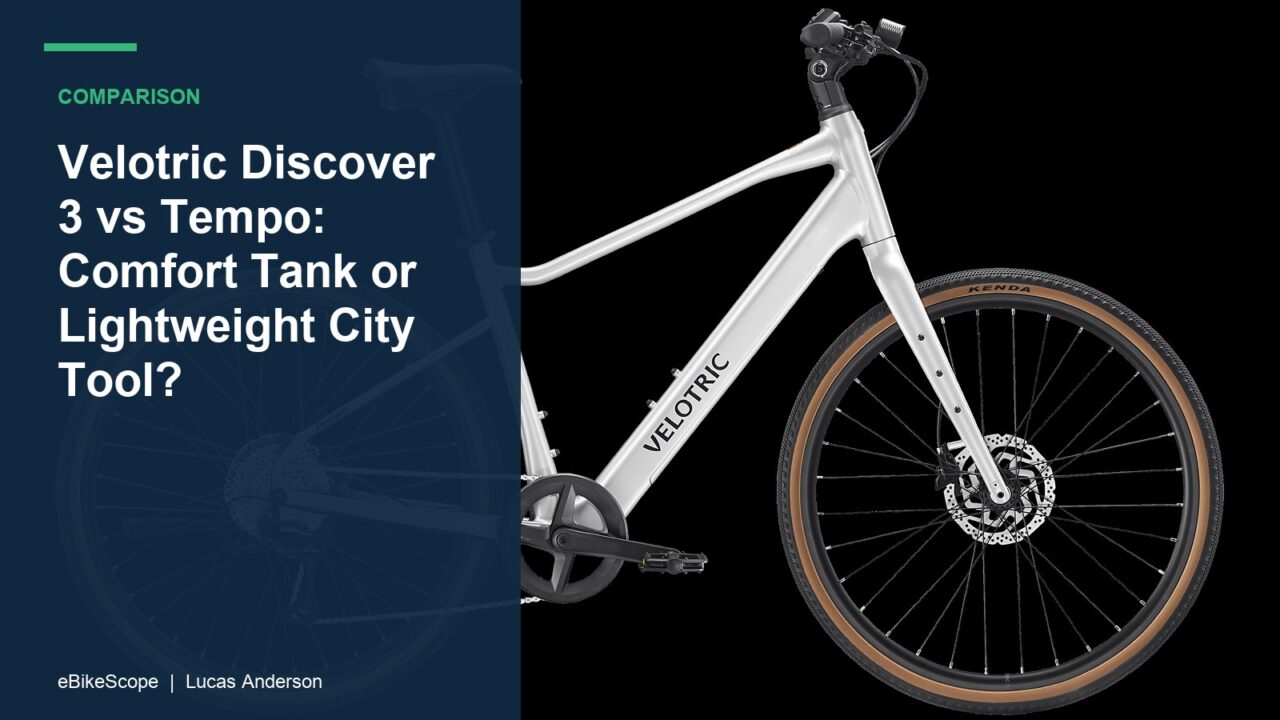
Velotric Discover 3 vs Tempo: Comfort Tank or Lightweight City Tool? comes down to one practical question: Choose between an equipped comfort commuter and a much lighter city platform without letting motor wattage hide storage and handling needs. Applied to Velotric Discover 3 vs Tempo, this check should use the exact configuration and normal weekly conditions rather than a category assumption.
The evidence here comes from current official product information and public rules relevant to Velotric Discover 3 Ebike, Velotric Tempo Ebike. The recommendations are editorial and need an exact-size fit check; no unprovided hands-on test is implied. That evidence belongs in the written Velotric Discover 3 vs Tempo comparison so a temporary price or display setting cannot quietly replace it.
A familiar model name can survive changes in hardware or software. Verify the current size, battery, charger, accessory number, class behavior, and seller terms instead of borrowing assumptions from another model year. In this Velotric Discover 3 vs Tempo guide, the point matters only when it changes a repeated trip, safety margin, or ownership task.
Two good bikes can solve different problems
A fair comparison identifies the central tradeoff first, then checks whether the paid capability is used often enough to justify its weight, service, and cost. For U.S. shoppers comparing two e-bikes for a real weekly routine, the key decision is this: Choose between an equipped comfort commuter and a much lighter city platform without letting motor wattage hide storage and handling needs. For this Velotric Discover 3 vs Tempo decision, keep that result tied to the rider, route, and ownership conditions defined above.
Current official model snapshot
| Model | Official price observed | Useful current-page details |
|---|---|---|
| Velotric Discover 3 Ebike | $1,999 | 750W hub motor, 730Wh battery, official maximum range up to 80 miles, 440 lb total capacity |
| Velotric Tempo Ebike | $1,499 | 39 lb city platform, removable 374Wh battery, SensorSwap modes, removable trigger throttle |
Prices and configurations are a current source check, not a guaranteed future offer. The official page and checkout control the transaction. Applied to Velotric Discover 3 vs Tempo, this check should use the exact configuration and normal weekly conditions rather than a category assumption.
Jump to the decision point
- The rider profile that changes the answer
- How the assistance should feel on the route
- How much energy margin is enough?
- Mounting, stopping, reach, and walking weight
- Posture, contact points, tires, and speed
- Payload is a handling question too
- Where will the complete bike live?
- Pay only for capability used every week
- Buyer questions
The rider profile that changes the answer
This decision is easy to distort with a maximum number or a temporary promotion. For U.S. shoppers comparing two e-bikes for a real weekly routine, keep the analysis centered on choose between an equipped comfort commuter and a much lighter city platform without letting motor wattage hide storage and handling needs. The checkpoint in this section is the rider profile that changes the answer. That evidence belongs in the written Velotric Discover 3 vs Tempo comparison so a temporary price or display setting cannot quietly replace it.
Describe a normal week in trips rather than adjectives. Distance, stops, surface, load, weather, parking, and who rides reveal which specifications have a recurring job. Applied to the rider profile that changes the answer, the implication is specific: Choose between an equipped comfort commuter and a much lighter city platform without letting motor wattage hide storage and handling needs. In this Velotric Discover 3 vs Tempo guide, the point matters only when it changes a repeated trip, safety margin, or ownership task.
For the the rider profile that changes the answer checkpoint, Velotric Discover 3 Ebike is currently listed at $1,999 and its official source highlights 750W hub motor, 730Wh battery, official maximum range up to 80 miles, 440 lb total capacity; while Velotric Tempo Ebike is currently listed at $1,499 and its official source highlights 39 lb city platform, removable 374Wh battery, SensorSwap modes, removable trigger throttle. Use the NHTSA bicycle safety guidance where its subject applies, then confirm narrower state, local, facility, or manufacturer instructions for the actual purchase. For this Velotric Discover 3 vs Tempo decision, keep that result tied to the rider, route, and ownership conditions defined above.
Use one low-risk session to test the exact requirement on Velotric Discover 3 Ebike, Velotric Tempo Ebike: repeated starts and stops, a tight turn, firm braking, walking, parking, loading, and the hardest normal route segment. Add speed, poor traction, cargo, or traffic only after control is predictable. Use this procedure specifically for the rider profile that changes the answer. Applied to Velotric Discover 3 vs Tempo, this check should use the exact configuration and normal weekly conditions rather than a category assumption.

How the assistance should feel on the route
For U.S. shoppers comparing two e-bikes for a real weekly routine, this part of Velotric Discover 3 vs Tempo should be treated as a pass-or-fail ownership question, not a point awarded to the longest specification sheet. The comparison must stay tied to choose between an equipped comfort commuter and a much lighter city platform without letting motor wattage hide storage and handling needs. The checkpoint in this section is how the assistance should feel on the route. That evidence belongs in the written Velotric Discover 3 vs Tempo comparison so a temporary price or display setting cannot quietly replace it.
Compare a low-speed start, sustained climb, rolling restart, tight turn, and low-assist cruise. Peak power can hide abrupt response, weak gearing, excess weight, or a sensor feel the rider does not enjoy. Applied to how the assistance should feel on the route, the implication is specific: Choose between an equipped comfort commuter and a much lighter city platform without letting motor wattage hide storage and handling needs. In this Velotric Discover 3 vs Tempo guide, the point matters only when it changes a repeated trip, safety margin, or ownership task.
For the how the assistance should feel on the route checkpoint, Velotric Discover 3 Ebike is currently listed at $1,999 and its official source highlights 750W hub motor, 730Wh battery, official maximum range up to 80 miles, 440 lb total capacity; while Velotric Tempo Ebike is currently listed at $1,499 and its official source highlights 39 lb city platform, removable 374Wh battery, SensorSwap modes, removable trigger throttle. Use the NHTSA bicycle safety guidance where its subject applies, then confirm narrower state, local, facility, or manufacturer instructions for the actual purchase. For this Velotric Discover 3 vs Tempo decision, keep that result tied to the rider, route, and ownership conditions defined above.
Before ordering Velotric Discover 3 Ebike, Velotric Tempo Ebike, ask the seller for a model-year-specific written answer whenever fit, capacity, compatibility, warranty, included hardware, or software behavior controls the purchase. Save the answer with the receipt because a general photograph is not a configuration promise. Use this procedure specifically for how the assistance should feel on the route. Applied to Velotric Discover 3 vs Tempo, this check should use the exact configuration and normal weekly conditions rather than a category assumption.
How much energy margin is enough?
The useful evidence for Velotric Discover 3 vs Tempo is the behavior of Velotric Discover 3 Ebike, Velotric Tempo Ebike under the same rider, route, setup, and load assumptions. This matters because choose between an equipped comfort commuter and a much lighter city platform without letting motor wattage hide storage and handling needs. The checkpoint in this section is how much energy margin is enough?. That evidence belongs in the written Velotric Discover 3 vs Tempo comparison so a temporary price or display setting cannot quietly replace it.
Keep an initial reserve for detours, cold, headwinds, battery aging, and a missed charge. Several representative rides can establish personal energy use far better than the most favorable published maximum. Applied to how much energy margin is enough?, the implication is specific: Choose between an equipped comfort commuter and a much lighter city platform without letting motor wattage hide storage and handling needs. In this Velotric Discover 3 vs Tempo guide, the point matters only when it changes a repeated trip, safety margin, or ownership task.
For the how much energy margin is enough? checkpoint, Velotric Discover 3 Ebike is currently listed at $1,999 and its official source highlights 750W hub motor, 730Wh battery, official maximum range up to 80 miles, 440 lb total capacity; while Velotric Tempo Ebike is currently listed at $1,499 and its official source highlights 39 lb city platform, removable 374Wh battery, SensorSwap modes, removable trigger throttle. Use the NHTSA bicycle safety guidance where its subject applies, then confirm narrower state, local, facility, or manufacturer instructions for the actual purchase. For this Velotric Discover 3 vs Tempo decision, keep that result tied to the rider, route, and ownership conditions defined above.
Use one low-risk session to test the exact requirement on Velotric Discover 3 Ebike, Velotric Tempo Ebike: repeated starts and stops, a tight turn, firm braking, walking, parking, loading, and the hardest normal route segment. Add speed, poor traction, cargo, or traffic only after control is predictable. Use this procedure specifically for how much energy margin is enough?. Applied to Velotric Discover 3 vs Tempo, this check should use the exact configuration and normal weekly conditions rather than a category assumption.

Mounting, stopping, reach, and walking weight
A shopper can make Velotric Discover 3 vs Tempo easier by writing the requirement before looking at another feature. For this article, the requirement follows directly from the buyer's situation: choose between an equipped comfort commuter and a much lighter city platform without letting motor wattage hide storage and handling needs. The checkpoint in this section is mounting, stopping, reach, and walking weight. That evidence belongs in the written Velotric Discover 3 vs Tempo comparison so a temporary price or display setting cannot quietly replace it.
Height ranges overlap and do not describe arm length, torso, flexibility, hand strength, or confidence. Record saddle height, reach, handlebar position, and any alternate parts used during a successful check. Applied to mounting, stopping, reach, and walking weight, the implication is specific: Choose between an equipped comfort commuter and a much lighter city platform without letting motor wattage hide storage and handling needs. In this Velotric Discover 3 vs Tempo guide, the point matters only when it changes a repeated trip, safety margin, or ownership task.
For the mounting, stopping, reach, and walking weight checkpoint, Velotric Discover 3 Ebike is currently listed at $1,999 and its official source highlights 750W hub motor, 730Wh battery, official maximum range up to 80 miles, 440 lb total capacity; while Velotric Tempo Ebike is currently listed at $1,499 and its official source highlights 39 lb city platform, removable 374Wh battery, SensorSwap modes, removable trigger throttle. Use the NHTSA bicycle safety guidance where its subject applies, then confirm narrower state, local, facility, or manufacturer instructions for the actual purchase. For this Velotric Discover 3 vs Tempo decision, keep that result tied to the rider, route, and ownership conditions defined above.
Before ordering Velotric Discover 3 Ebike, Velotric Tempo Ebike, ask the seller for a model-year-specific written answer whenever fit, capacity, compatibility, warranty, included hardware, or software behavior controls the purchase. Save the answer with the receipt because a general photograph is not a configuration promise. Use this procedure specifically for mounting, stopping, reach, and walking weight. Applied to Velotric Discover 3 vs Tempo, this check should use the exact configuration and normal weekly conditions rather than a category assumption.
Posture, contact points, tires, and speed
This decision is easy to distort with a maximum number or a temporary promotion. For U.S. shoppers comparing two e-bikes for a real weekly routine, keep the analysis centered on choose between an equipped comfort commuter and a much lighter city platform without letting motor wattage hide storage and handling needs. The checkpoint in this section is posture, contact points, tires, and speed. That evidence belongs in the written Velotric Discover 3 vs Tempo comparison so a temporary price or display setting cannot quietly replace it.
Comfort is dynamic. Posture, tire pressure, saddle support, grip angle, cadence, clothing, and speed can matter as much as suspension travel, especially on repeated pavement routes. Applied to posture, contact points, tires, and speed, the implication is specific: Choose between an equipped comfort commuter and a much lighter city platform without letting motor wattage hide storage and handling needs. In this Velotric Discover 3 vs Tempo guide, the point matters only when it changes a repeated trip, safety margin, or ownership task.
For the posture, contact points, tires, and speed checkpoint, Velotric Discover 3 Ebike is currently listed at $1,999 and its official source highlights 750W hub motor, 730Wh battery, official maximum range up to 80 miles, 440 lb total capacity; while Velotric Tempo Ebike is currently listed at $1,499 and its official source highlights 39 lb city platform, removable 374Wh battery, SensorSwap modes, removable trigger throttle. Use the NHTSA bicycle safety guidance where its subject applies, then confirm narrower state, local, facility, or manufacturer instructions for the actual purchase. For this Velotric Discover 3 vs Tempo decision, keep that result tied to the rider, route, and ownership conditions defined above.
Evaluate the completed setup for Velotric Discover 3 Ebike, Velotric Tempo Ebike, not an empty display bike. Racks, baskets, passenger parts, locks, mirrors, alternate posts, fenders, and transport equipment can change weight, clearance, fit, charging access, handling, and first-year cost. Use this procedure specifically for posture, contact points, tires, and speed. Applied to Velotric Discover 3 vs Tempo, this check should use the exact configuration and normal weekly conditions rather than a category assumption.

Payload is a handling question too
For U.S. shoppers comparing two e-bikes for a real weekly routine, this part of Velotric Discover 3 vs Tempo should be treated as a pass-or-fail ownership question, not a point awarded to the longest specification sheet. The comparison must stay tied to choose between an equipped comfort commuter and a much lighter city platform without letting motor wattage hide storage and handling needs. The checkpoint in this section is payload is a handling question too. That evidence belongs in the written Velotric Discover 3 vs Tempo comparison so a temporary price or display setting cannot quietly replace it.
A high capacity number does not approve a passenger. Use only the manufacturer's compatible passenger system, confirm local age and helmet rules, and protect feet and clothing from the wheel and drivetrain. Applied to payload is a handling question too, the implication is specific: Choose between an equipped comfort commuter and a much lighter city platform without letting motor wattage hide storage and handling needs. In this Velotric Discover 3 vs Tempo guide, the point matters only when it changes a repeated trip, safety margin, or ownership task.
For the payload is a handling question too checkpoint, Velotric Discover 3 Ebike is currently listed at $1,999 and its official source highlights 750W hub motor, 730Wh battery, official maximum range up to 80 miles, 440 lb total capacity; while Velotric Tempo Ebike is currently listed at $1,499 and its official source highlights 39 lb city platform, removable 374Wh battery, SensorSwap modes, removable trigger throttle. Use the NHTSA bicycle safety guidance where its subject applies, then confirm narrower state, local, facility, or manufacturer instructions for the actual purchase. For this Velotric Discover 3 vs Tempo decision, keep that result tied to the rider, route, and ownership conditions defined above.
Turn that principle into a repeatable test for Velotric Discover 3 Ebike, Velotric Tempo Ebike. Use normal shoes, clothing, lock, bags, and representative cargo; keep tire pressure and assistance assumptions consistent; then record what succeeds, what fails, and what would need paid equipment or professional labor. Use this procedure specifically for payload is a handling question too. Applied to Velotric Discover 3 vs Tempo, this check should use the exact configuration and normal weekly conditions rather than a category assumption.
Where will the complete bike live?
The useful evidence for Velotric Discover 3 vs Tempo is the behavior of Velotric Discover 3 Ebike, Velotric Tempo Ebike under the same rider, route, setup, and load assumptions. This matters because choose between an equipped comfort commuter and a much lighter city platform without letting motor wattage hide storage and handling needs. The checkpoint in this section is where will the complete bike live?. That evidence belongs in the written Velotric Discover 3 vs Tempo comparison so a temporary price or display setting cannot quietly replace it.
Ask a nearby shop what it will service before ordering. Separate ordinary bicycle work from electrical diagnosis, warranty labor, proprietary parts, suspension, cargo hardware, and wheel service. Applied to where will the complete bike live?, the implication is specific: Choose between an equipped comfort commuter and a much lighter city platform without letting motor wattage hide storage and handling needs. In this Velotric Discover 3 vs Tempo guide, the point matters only when it changes a repeated trip, safety margin, or ownership task.
For the where will the complete bike live? checkpoint, Velotric Discover 3 Ebike is currently listed at $1,999 and its official source highlights 750W hub motor, 730Wh battery, official maximum range up to 80 miles, 440 lb total capacity; while Velotric Tempo Ebike is currently listed at $1,499 and its official source highlights 39 lb city platform, removable 374Wh battery, SensorSwap modes, removable trigger throttle. Use the NHTSA bicycle safety guidance where its subject applies, then confirm narrower state, local, facility, or manufacturer instructions for the actual purchase. For this Velotric Discover 3 vs Tempo decision, keep that result tied to the rider, route, and ownership conditions defined above.
Use one low-risk session to test the exact requirement on Velotric Discover 3 Ebike, Velotric Tempo Ebike: repeated starts and stops, a tight turn, firm braking, walking, parking, loading, and the hardest normal route segment. Add speed, poor traction, cargo, or traffic only after control is predictable. Use this procedure specifically for where will the complete bike live?. Applied to Velotric Discover 3 vs Tempo, this check should use the exact configuration and normal weekly conditions rather than a category assumption.

Pay only for capability used every week
A shopper can make Velotric Discover 3 vs Tempo easier by writing the requirement before looking at another feature. For this article, the requirement follows directly from the buyer's situation: choose between an equipped comfort commuter and a much lighter city platform without letting motor wattage hide storage and handling needs. The checkpoint in this section is pay only for capability used every week. That evidence belongs in the written Velotric Discover 3 vs Tempo comparison so a temporary price or display setting cannot quietly replace it.
Name the recurring problem solved by every paid upgrade. If the answer depends on an imagined once-a-year trip, keep the money for security, service, or a future battery. Applied to pay only for capability used every week, the implication is specific: Choose between an equipped comfort commuter and a much lighter city platform without letting motor wattage hide storage and handling needs. In this Velotric Discover 3 vs Tempo guide, the point matters only when it changes a repeated trip, safety margin, or ownership task.
For the pay only for capability used every week checkpoint, Velotric Discover 3 Ebike is currently listed at $1,999 and its official source highlights 750W hub motor, 730Wh battery, official maximum range up to 80 miles, 440 lb total capacity; while Velotric Tempo Ebike is currently listed at $1,499 and its official source highlights 39 lb city platform, removable 374Wh battery, SensorSwap modes, removable trigger throttle. Use the NHTSA bicycle safety guidance where its subject applies, then confirm narrower state, local, facility, or manufacturer instructions for the actual purchase. For this Velotric Discover 3 vs Tempo decision, keep that result tied to the rider, route, and ownership conditions defined above.
Turn that principle into a repeatable test for Velotric Discover 3 Ebike, Velotric Tempo Ebike. Use normal shoes, clothing, lock, bags, and representative cargo; keep tire pressure and assistance assumptions consistent; then record what succeeds, what fails, and what would need paid equipment or professional labor. Use this procedure specifically for pay only for capability used every week. Applied to Velotric Discover 3 vs Tempo, this check should use the exact configuration and normal weekly conditions rather than a category assumption.
Run the same-route comparison
Set up Velotric Discover 3 Ebike, Velotric Tempo Ebike for the same rider, pressure, assistance class, cargo, and route. Compare the awkward start, sustained hill, controlled stop, tight turn, walking maneuver, storage path, and charging task rather than a short high-assist cruise. That evidence belongs in the written Velotric Discover 3 vs Tempo comparison so a temporary price or display setting cannot quietly replace it.
Audit the price difference
Assign each dollar of difference a repeated job. Battery, security, suspension, rack capacity, lower weight, or dealer support earns money only when it changes a normal week. Keep safety equipment, setup, service, and transport in both totals. In this Velotric Discover 3 vs Tempo guide, the point matters only when it changes a repeated trip, safety margin, or ownership task.
Write one deciding sentence
Finish with: choose one of Velotric Discover 3 Ebike, Velotric Tempo Ebike because it solves a named recurring problem better; choose the other because the first model's added weight, cost, maintenance, or limited fit would be felt more often than its extra capability. For this Velotric Discover 3 vs Tempo decision, keep that result tied to the rider, route, and ownership conditions defined above.
Keep comparing before checkout
Continue with One E-Bike, Two Riders: Best Velotric Models for Couples to Share, Desert Heat vs Your Battery: Choosing a Velotric for Hot Climates, Best Velotric for Pacific Northwest Rain and Year-Round Commuting, and the Velotric model guide. Applied to Velotric Discover 3 vs Tempo, this check should use the exact configuration and normal weekly conditions rather than a category assumption.
Questions buyers ask before deciding
Who is Velotric Discover 3 vs Tempo best for?
It fits U.S. shoppers comparing two e-bikes for a real weekly routine when the exact model or setup passes fit, route, storage, charging, legal, and service requirements. Choose between an equipped comfort commuter and a much lighter city platform without letting motor wattage hide storage and handling needs. A promotion cannot repair a missed non-negotiable. That evidence belongs in the written Velotric Discover 3 vs Tempo comparison so a temporary price or display setting cannot quietly replace it.
What should I verify before buying Velotric Discover 3 Ebike, Velotric Tempo Ebike?
Verify the exact model year, size, included equipment, battery and charger, current price, delivery and return terms, local service, accessory compatibility, and completed-bike weight for Velotric Discover 3 Ebike, Velotric Tempo Ebike. Save written answers that affect capacity or coverage. In this Velotric Discover 3 vs Tempo guide, the point matters only when it changes a repeated trip, safety margin, or ownership task.
How should I judge plan battery reserve, not maximum miles?
Use identical conditions and keep reserve. Keep an initial reserve for detours, cold, headwinds, battery aging, and a missed charge. Several representative rides can establish personal energy use far better than the most favorable published maximum. Confirm current manufacturer instructions before treating a published maximum as a personal result. For this Velotric Discover 3 vs Tempo decision, keep that result tied to the rider, route, and ownership conditions defined above.
What ownership cost is easiest to miss with Velotric Discover 3 vs Tempo?
Security, professional setup, a compatible rack or cargo system, transport to service, routine tires and brakes, downtime, and eventual battery replacement often sit outside the advertised price. Build a first-year and long-term total. Applied to Velotric Discover 3 vs Tempo, this check should use the exact configuration and normal weekly conditions rather than a category assumption.
What is the safest final test before choosing Velotric Discover 3 Ebike, Velotric Tempo Ebike?
Use the exact size and closest configuration in a low-risk place. Repeat starts, progressive and emergency braking, a tight turn, shoulder check, walking, loading, storage, and the hardest normal route segment before adding speed or traffic. That evidence belongs in the written Velotric Discover 3 vs Tempo comparison so a temporary price or display setting cannot quietly replace it.
What should you buy?
For U.S. shoppers comparing two e-bikes for a real weekly routine, choose Velotric Discover 3 Ebike, Velotric Tempo Ebike only when the exact configuration satisfies the non-negotiable fit, route, storage, charging, legal, security, and service requirements with useful reserve. The central decision remains: Choose between an equipped comfort commuter and a much lighter city platform without letting motor wattage hide storage and handling needs. Buy capability that solves a repeated problem and prefer simplicity when added weight, cost, or maintenance would be felt more often than the feature. In this Velotric Discover 3 vs Tempo guide, the point matters only when it changes a repeated trip, safety margin, or ownership task.
Check the exact configuration on the official Velotric Discover 3 Ebike page. Code REF601753 may provide $60 off when eligible; the current Velotric checkout and terms are the final authority. For this Velotric Discover 3 vs Tempo decision, keep that result tied to the rider, route, and ownership conditions defined above.