
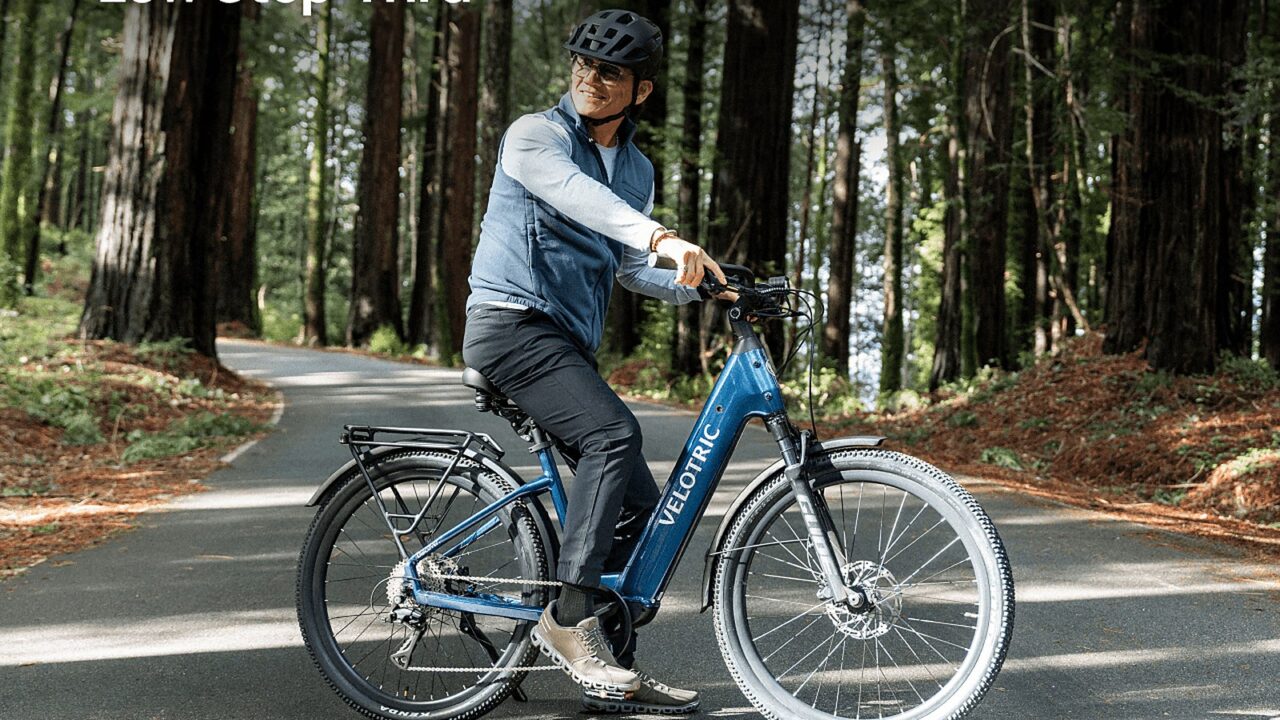
A height chart is a filter, not a fitting. Velotric offers Regular and Large sizes, high-step and mid-step frames, low step-through cruisers, compact utility bikes, folding bikes, and a trike. Two riders at the same height can need different setups because inseam, torso length, arm length, flexibility, balance, and cargo all affect fit.
This guide translates the current official ranges into a test process for U.S. buyers. Geometry and included seatposts can change, so confirm the current product page and ask a dealer when near a boundary.
Bring these measurements
- Barefoot inseam
- Current comfortable saddle height
- Door and storage width
- Maximum rider-plus-cargo load
- The shoes and clothing used for riding
In this guide
- Measure inseam before reading the chart
- Minimum saddle height is often the deciding number
- Stand-over height and step-through clearance
- Reach controls hands, shoulders, and confidence
- How to choose within overlapping sizes
- Mobility needs can outweigh performance
- Weight capacity is separate from size
- Wheel and bike weight affect low-speed control
- A dealer test-ride checklist
- Ordering online near a boundary
- Frequently asked questions
- Bottom line
Specifications that matter
| Item | Official specification or policy |
|---|---|
| Discover 3 / M | Regular 5'2-5'11; Large 5'9-6'7 with suspension post |
| Breeze 1 | Regular 4'11-5'8; Large 5'6-6'4 |
| Tempo | Four frame/size ranges from 4'10 to 6'4 |
| Nomad 2X | Step-through 4'11-5'10; high-step 5'10-6'5 |
| Triker | One size, 4'10-6'5 |
Specifications and current configurations can be checked on Velotric Discover 3 official product page, Velotric Discover M official product page, Velotric Breeze 1 official product page, Velotric Tempo official product page, Velotric Nomad 2X official product page, Velotric Triker official product page.

Measure inseam before reading the chart
Stand barefoot against a wall with a book pressed upward to simulate saddle contact, then measure floor to book. This does not equal stand-over clearance, but it provides a repeatable body measurement beyond total height. A correct setup should feel controlled during mounting, stopping, turning, and walking as well as while cruising.
Record everyday shoe thickness and any mobility limitation. A dealer can use the number with minimum saddle height and frame geometry.
Minimum saddle height is often the deciding number
A rider must reach the pedals with safe knee extension and feel in control when starting and stopping. Suspension posts can raise the lowest available saddle position compared with rigid posts. Small adjustments can refine a suitable frame, but they cannot rescue a frame whose basic saddle range or reach is wrong.
Discover M and Discover 3 publish alternate fit ranges without the suspension seatpost. Shorter riders should confirm which post and saddle create the advertised minimum.

Stand-over height and step-through clearance
Stand-over describes clearance above the frame, while a step-through opening affects how high the rider must lift a foot when mounting. They solve related but different problems. A correct setup should feel controlled during mounting, stopping, turning, and walking as well as while cruising.
Wear the clothing and shoes used for riding, add any rear cargo, and repeat mounting from both sides. A rack bag can make a high rear leg swing impossible.
Reach controls hands, shoulders, and confidence
A low frame does not guarantee a short cockpit. Reach depends on frame length, stem, bar sweep, saddle position, and rider torso and arm length. Small adjustments can refine a suitable frame, but they cannot rescue a frame whose basic saddle range or reach is wrong.
The rider should steer fully without locking elbows or folding excessively at the hips. Adjustable stems help but should not compensate for a fundamentally wrong frame.

How to choose within overlapping sizes
Velotric size ranges often overlap. Smaller frames can feel more compact and easier to maneuver; larger frames can provide more room and stability for riders with longer torsos. A correct setup should feel controlled during mounting, stopping, turning, and walking as well as while cruising.
Choose after testing saddle range and reach, not by assuming taller always means Large. Compare both sizes on starts, slow turns, and a normal riding position.
Mobility needs can outweigh performance
Hip, knee, back, balance, or hand limitations can make a low step-through, upright bar, or lighter bike more important than battery or motor specifications. Practice in a low-risk area before adding speed, cargo, passengers, traffic, or uneven terrain.
No geometry chart can diagnose a medical limitation. Use a test ride, professional fit, and qualified health advice when needed.

Weight capacity is separate from size
A bike may fit a rider's height but not the combined rider-and-cargo load. Discover models list 440 pounds, Breeze and Tempo 330 pounds, Nomad 2X 560 pounds, and Triker 500 pounds. Published capacity is a ceiling under specified conditions, not a target for everyday use.
Stay below the total limit and verify rack, wheel, tire, seatpost, and accessory limits. Larger capacity does not automatically mean a larger frame is appropriate.
Wheel and bike weight affect low-speed control
Tall 27.5-inch commuters, compact 20-inch utility bikes, and wide trikes react differently during parking and tight turns. A frame that feels comfortable at speed may still be difficult to walk or store. Handling should be judged with the intended tire pressure, fit, and normal cargo rather than an empty display bike alone.
Include pushing, backing, using the kickstand, and navigating a doorway in the fit test. These are daily fit tasks, not separate ownership issues.

A dealer test-ride checklist
Set saddle height, check brake-lever reach, mount repeatedly, start on a slight incline, make a U-turn, stop abruptly in a safe area, and walk the bike. Test the exact frame and seatpost configuration being purchased. Describe a normal Tuesday ride before planning an exceptional weekend, because the routine should determine the purchase.
Do not let a display bike with a different saddle or stem stand in for the ordered setup. Ask the dealer to document adjustments.
Ordering online near a boundary
If no test ride is available, save screenshots of the current geometry table, confirm return costs, and ask support about minimum saddle height with the included post. Keep packaging until fit is settled. Ask who will perform the first adjustment and where model-specific electrical support is available.
Online convenience does not eliminate restocking fees or disassembly work. A few precise questions before purchase are cheaper than returning a boxed e-bike.

Record the whole-body fit
For Velotric Discover 3 and Velotric Discover M and Velotric Breeze 1 and Velotric Tempo and Velotric Nomad 2X and Velotric Triker, note saddle height, knee bend, reach, elbow position, wrist angle, and the ability to look behind. Repeat after ten or fifteen minutes because a posture that feels fine at first can become tiring. Fit is a system: moving the saddle to solve reach also changes pedaling position, and rotating the bar can change brake access. Make one adjustment at a time and record the result.
Rehearse mounting with real cargo
A rear basket, child seat, or tall rack bag can remove the space used to swing a leg. Mount and dismount with an equivalent obstacle while the bike is safely supported. Check both sides and a slight incline. Riders with limited mobility should prioritize a frame opening that works in ordinary clothing and after fatigue, not only during a fresh showroom demonstration.
Fit the controls as well as the frame
Brake levers should be reachable without rotating the hand off the grip, the display should be readable without staring down, and assist controls should be identifiable by touch after practice. Ask whether lever reach and bar angle are adjustable. A correct frame with poorly positioned controls can still reduce confidence, especially during emergency braking or winter-glove use.
Verify the stored-bike fit
Measure overall length, handlebar width, tire width, and the turning space needed to reach storage. Include mirrors, baskets, racks, and pedals. A bike can fit a rider perfectly yet fail the elevator or doorway. For vertical storage, confirm weight and frame-contact rules; for vehicle transport, confirm per-bike capacity and wheel retention before ordering.
Document the final setup
Once the correct configuration is found, record saddle insertion, stem angle, tire pressure range, suspension pressure if applicable, and control settings. A photograph and simple measurements make it easier to restore fit after transport or service. Shared bikes should have separate records for each rider, while still respecting minimum insertion marks and all manufacturer limits.
Save the final fit sheet
Before paying for Velotric Discover 3, Velotric Discover M, Velotric Breeze 1, Velotric Tempo, Velotric Nomad 2X, Velotric Triker, write a one-page decision that addresses measure inseam before reading the chart, stand-over height and step-through clearance, how to choose within overlapping sizes, and weight capacity is separate from size. Use the rider's actual measurements, route, load, storage, charging location, and service access. A written record exposes contradictions that are easy to overlook while comparing colorful product pages. It also creates a useful list for a dealer or support representative, who can confirm whether the selected size, accessory, battery, and class configuration matches the intended use.
Save the current official page for Velotric Discover 3, Velotric Discover M, Velotric Breeze 1, Velotric Tempo, Velotric Nomad 2X, Velotric Triker, the cart showing included equipment, the return and warranty terms, and any written compatibility answer. Product bundles and prices can change between research and checkout. Confirm model year, frame, color, charger, battery, rack or passenger hardware, and delivery method on the final order. Do not rely on a review photograph to establish what comes in the box. If a feature is essential, it should appear in the current specification or in a direct written answer from the seller.
During the first month, revisit minimum saddle height is often the deciding number, reach controls hands, shoulders, and confidence, mobility needs can outweigh performance, and a dealer test-ride checklist. Record tire pressure, assist mode, distance, battery use, weather, cargo, and any fit or brake adjustment. Small early corrections can improve comfort and reliability, while repeated problems may indicate that the model or setup is wrong. Keep packaging until the return window and condition are understood, register the bike promptly, and follow the manual's inspection schedule. This turns a buying guide into an ownership baseline instead of letting the research disappear after checkout.
Continue the buying research
Compare this decision with our step-through buyer's guide, what first-time buyers should know. These guides cover the route, fit, safety, and ownership questions that a single product page cannot settle.
Frequently asked questions
Should I size up for stability?
Not automatically. Size up only when saddle range, reach, and handling support it. A frame that is too large can make starts and stops less confident.
Is step-through only for shorter riders?
No. Step-through frames help riders of many heights, especially with cargo, work clothing, or limited hip mobility.
Can I replace the suspension seatpost to fit?
Some official fit ranges change with a rigid post, but confirm diameter, insertion, saddle height, and warranty implications with Velotric or a dealer.
What if I am exactly between sizes?
Test both if possible. Torso length, reach preference, saddle range, and intended handling are more useful than height alone.
Bottom line
Use Velotric's height range to identify candidates, then fit by saddle height, stand-over, reach, mobility, load, and low-speed control. Buyers near an overlap should test both sizes. The best frame is the one that remains comfortable not only while cruising, but also while mounting, stopping, parking, and storing the bike.
Check the current configuration before checkout
Visit the official Velotric Discover 3 page to confirm color, size, included accessories, shipping, and current price. Code REF601753 may provide $60 off when eligible; Velotric’s checkout and current terms are the final authority.
Before placing the order
Write down the actual weekly mileage, steepest grade, storage route, charging location, normal cargo, and service shop. Compare those facts with the model’s weight, battery, frame, brakes, and included equipment. This short exercise prevents a headline specification from outweighing the practical details that determine whether the bike is easy to use after delivery.
A sensible first-month plan
Begin in the lowest useful assist mode, confirm tire pressure and fasteners, practice braking and low-speed turns, and increase speed gradually. Recheck the manual after the first rides, schedule any recommended inspection, and record battery use on the real route. Personal data quickly becomes more useful than a generic range claim.
What a product page cannot decide
A manufacturer can publish dimensions, certifications, and component specifications, but it cannot know the rider’s balance, local traffic, stairs, weather, trail rules, or access to service. Those are not minor exceptions. They are part of the purchase and deserve the same attention as motor output and advertised range.