
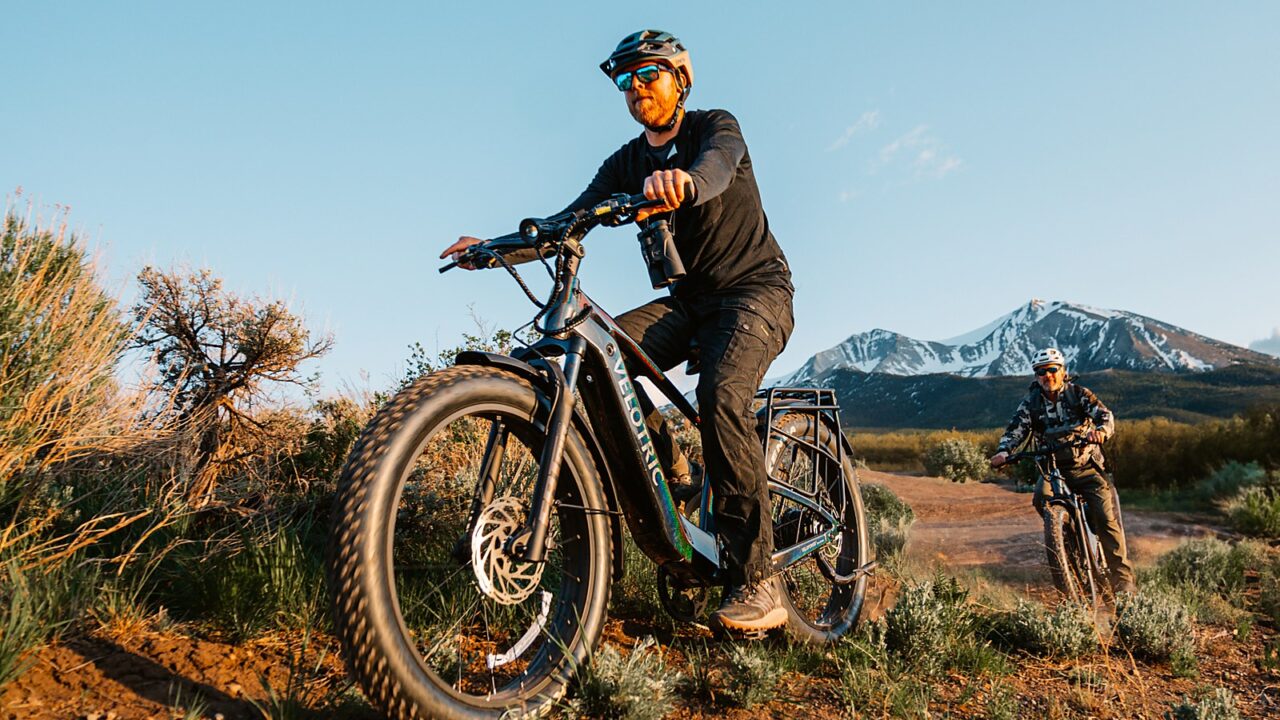
Nomad 2X adds full air suspension, a larger battery, greater payload ratings, and more aggressive off-road hardware to the Nomad formula. Nomad 2 keeps the familiar fat-tire shape with a suspension fork and lower price. The correct choice depends less on how rugged the photos look and more on surface, transport, maintenance, and how often rear suspension will actually work.
This comparison uses Velotric's official specifications and does not represent a personal trail test. On August 19, 2026, the product feeds listed Nomad 2X at $2,399 and Nomad 2 at $1,749; color or package pricing can vary.
The decision in one minute
- Choose the higher-spec option only when its motor, suspension, or battery solves a repeated route problem.
- Choose the value option when the route is smoother, storage is tighter, or the price difference funds more useful safety and cargo equipment.
In this guide
- Rear suspension: benefit, cost, and purpose
- The front-end hardware is also different
- Power and climbing under load
- Payload and towing numbers need context
- Frame choice can decide before suspension
- Range difference versus real consumption
- Transport may be the hidden deal breaker
- Maintenance on a full-suspension fat bike
- Stealth Mode and outdoor use
- The value decision
- Frequently asked questions
- Bottom line
Specifications that matter
| Decision point | Velotric Nomad 2X | Velotric Nomad 2 |
|---|---|---|
| Motor | 750W / 105Nm | 750W / 90Nm |
| Battery / range | 801.6Wh / up to 75 miles | 705.6Wh / up to 65 miles |
| Suspension | 120mm air fork + 80mm rear wheel travel | 100mm hydraulic fork |
| Weight / total load | 80 lb / 560 lb | 75 lb / 505 lb |
| Official price checked | $2,399 | $1,749 |
Specifications and current configurations can be checked on Velotric Nomad 2X official product page, Velotric Nomad 2 official product page.

Rear suspension: benefit, cost, and purpose
Nomad 2X adds an air rear shock and 80mm of rear-wheel travel, while Nomad 2 is a hardtail with only front suspension. Rear travel can improve comfort and tire contact on washboard, roots, and repeated rough impacts. The useful question is how often that condition appears, not whether the bike can encounter it once.
On pavement, groomed paths, and occasional gravel, tire volume and a suspension seatpost may provide enough comfort. Full suspension earns its cost when rough surfaces are frequent, not merely possible.
The front-end hardware is also different
Nomad 2X uses a 120mm air fork with rebound adjustment and larger 203mm front brake rotor. Nomad 2 lists a 100mm hydraulic suspension fork and 180mm front rotor. Handling should be judged with the intended tire pressure, fit, and normal cargo rather than an empty display bike alone.
Air suspension offers more tuning for rider weight and terrain but requires setup. Buyers unwilling to learn pressure and rebound settings may not receive the full benefit.

Power and climbing under load
Both use 750W hub motors, but Nomad 2X lists 105Nm versus Nomad 2's 90Nm. The 2X also carries more battery and can support a higher combined load. The useful question is how often that condition appears, not whether the bike can encounter it once.
The 2X is the stronger specification for heavy gear and steep loose surfaces. On level roads, the five-pound weight increase and more complex chassis may matter more than the extra torque.
Payload and towing numbers need context
Nomad 2X lists 560 pounds total payload, a 120-pound rack, and up to 1,000 pounds towing capacity. Nomad 2 lists 505 pounds total load. Towing claims do not describe every trailer, hitch, grade, or braking condition. Practice in a low-risk area before adding speed, cargo, passengers, traffic, or uneven terrain.
Confirm approved towing hardware directly with Velotric and the trailer maker. Begin well below maximum claims and understand that descents, turns, and stopping are the limiting situations.

Frame choice can decide before suspension
Nomad 2X divides fit by frame: step-through for 4 feet 11 inches to 5 feet 10 inches and high-step for 5 feet 10 inches to 6 feet 5 inches. Nomad 2 offers Regular and Large ranges with different frame options. A correct setup should feel controlled during mounting, stopping, turning, and walking as well as while cruising.
A rider near 5 feet 10 inches should test both 2X frames rather than assuming either will work. Stand-over, reach, saddle height, and dismount confidence matter on loose ground.
Range difference versus real consumption
The 2X's 801.6Wh battery and 75-mile claim exceed the Nomad 2's 705.6Wh and 65-mile claim. Four-inch tires, high assist, soft terrain, cold weather, and heavy loads reduce both. The most honest comparison uses battery watt-hours and route conditions together instead of treating claimed miles as fixed.
Compare watt-hours first and treat the maximum miles as a best-case reference. Carrying a reserve plan matters more than chasing a precise marketing number on remote rides.

Transport may be the hidden deal breaker
Nomad 2X weighs 80 pounds and Nomad 2 weighs 75 pounds before some accessories. Fat tires and long wheelbases limit the compatible hitch racks, and neither is friendly to stairs. Solve storage, charging, transport, and service before purchase because those constraints remain after the novelty fades.
Check per-bike rack capacity, tray length, tire width, fender interference, hitch tongue limits, and lifting height. Removing the battery may reduce lift weight but does not change the bike's dimensions.
Maintenance on a full-suspension fat bike
Nomad 2X adds pivots, bushings, an air shock, and more suspension adjustments. Those parts increase capability and also create inspection and service points beyond a hardtail. Ask who will perform the first adjustment and where model-specific electrical support is available.
Ask a nearby shop whether it services the specific fork and shock. A lower purchase price is not the only savings if Nomad 2 better matches the terrain.

Stealth Mode and outdoor use
Nomad 2X includes a Stealth Mode intended to dim the display, switch lights off, and reduce speed for low-profile use. It does not make a motorized bike legal on closed trails or guarantee silence. Describe a normal Tuesday ride before planning an exceptional weekend, because the routine should determine the purchase.
Hunting, wildlife, park, and land-manager rules still control access. Confirm permission for the exact area and season before treating any e-bike feature as access authorization.
The value decision
The official price gap was $650 at the time checked. That buys full suspension, a larger battery, stronger published torque and load ratings, and a more capable brake and fork package. A feature is worth paying for when it solves a repeated use case; an impressive specification with no regular job is just added cost.
Choose 2X when those features solve repeated terrain or load problems. Choose Nomad 2 for pavement, gravel roads, beach approaches, and recreational use where simplicity and savings win.

Audit the price gap
List every hardware difference between Velotric Nomad 2X and Velotric Nomad 2, then assign a job to each one. A larger battery should cover a recurring distance problem; stronger suspension should address a surface ridden often; a different motor should improve the hills actually on the route. If a feature has no regular job, its share of the price gap is difficult to justify. This keeps the decision centered on use instead of assuming the more expensive model is automatically the safer purchase.
Compare three versions of the route
Evaluate an ordinary weekday, the hardest normal day, and an occasional recreational day. The ordinary ride establishes whether the lower-cost model is already sufficient. The hardest normal day reveals the battery, climbing, braking, or load reserve that may justify an upgrade. The occasional day should break a tie only when it happens often enough to influence ownership. A bike that excels on one annual trip but frustrates daily storage is poorly matched.
Think beyond the first season
Over several years, tires, brake pads, chains, cassettes, suspension service, batteries, accessories, and shop labor can matter more than the original price difference. More capable hardware may be worthwhile when it reduces strain on the bike or owner, but extra systems can also add maintenance. Ask the service shop what it stocks, what it can diagnose, and what common wear items cost before using purchase price as the only value measure.
Make the test ride repeatable
Set both bikes to comparable assist and class settings, use the same hill, and repeat the same start, stop, turn, and walking maneuver. A test is less useful when one display bike has different tire pressure, saddle position, or cargo. Take notes immediately after each ride. The better model is the one whose advantages remain obvious under equal conditions, not the one presented first or configured more aggressively.
Use a clear tie-breaker
When both options fit, meet the route, and have local support, choose the model that leaves more budget for a fitted helmet, high-quality lock, visibility equipment, cargo setup, and initial service. Those purchases affect every ride. Pay the premium when the higher model's defining feature changes comfort, control, or reliability on a repeated route. Otherwise, simplicity and financial margin are valid performance features of their own.
Write down why one model wins
Before paying for Velotric Nomad 2X, Velotric Nomad 2, write a one-page decision that addresses rear suspension: benefit, cost, and purpose, power and climbing under load, frame choice can decide before suspension, and transport may be the hidden deal breaker. Use the rider's actual measurements, route, load, storage, charging location, and service access. A written record exposes contradictions that are easy to overlook while comparing colorful product pages. It also creates a useful list for a dealer or support representative, who can confirm whether the selected size, accessory, battery, and class configuration matches the intended use.
Save the current official page for Velotric Nomad 2X, Velotric Nomad 2, the cart showing included equipment, the return and warranty terms, and any written compatibility answer. Product bundles and prices can change between research and checkout. Confirm model year, frame, color, charger, battery, rack or passenger hardware, and delivery method on the final order. Do not rely on a review photograph to establish what comes in the box. If a feature is essential, it should appear in the current specification or in a direct written answer from the seller.
During the first month, revisit the front-end hardware is also different, payload and towing numbers need context, range difference versus real consumption, and stealth mode and outdoor use. Record tire pressure, assist mode, distance, battery use, weather, cargo, and any fit or brake adjustment. Small early corrections can improve comfort and reliability, while repeated problems may indicate that the model or setup is wrong. Keep packaging until the return window and condition are understood, register the bike promptly, and follow the manual's inspection schedule. This turns a buying guide into an ownership baseline instead of letting the research disappear after checkout.
Continue the buying research
Compare this decision with our Nomad 2 overview, the fat-tire versus commuter guide. These guides cover the route, fit, safety, and ownership questions that a single product page cannot settle.
Frequently asked questions
Is Nomad 2X faster than Nomad 2?
Both can be configured up to 28 mph where legal. The 2X emphasizes terrain control and load capability rather than a higher top-speed claim.
Can Nomad 2X carry two batteries?
The current official specification lists one 801.6Wh battery. Do not assume dual-battery compatibility unless Velotric explicitly confirms the configuration.
Which is better for pavement?
Nomad 2 is usually the better value for mainly paved use. The 2X can be more comfortable, but full suspension and added cost are not essential on smooth routes.
Are either true mountain bikes?
They are powerful fat-tire e-bikes, not substitutes for lightweight trail mountain bikes. Observe terrain, component, and land-access limits.
Bottom line
Nomad 2X is the capability purchase: rough surfaces, higher loads, tunable suspension, and serious outdoor equipment. Nomad 2 is the efficiency purchase: lower price, fewer suspension parts, and enough fat-tire versatility for many recreational riders. Buy for the surface ridden every week, not the most dramatic trip imagined once a year.
Check the current configuration before checkout
Visit the official Velotric Nomad 2X page to confirm color, size, included accessories, shipping, and current price. Code REF601753 may provide $60 off when eligible; Velotric’s checkout and current terms are the final authority.