
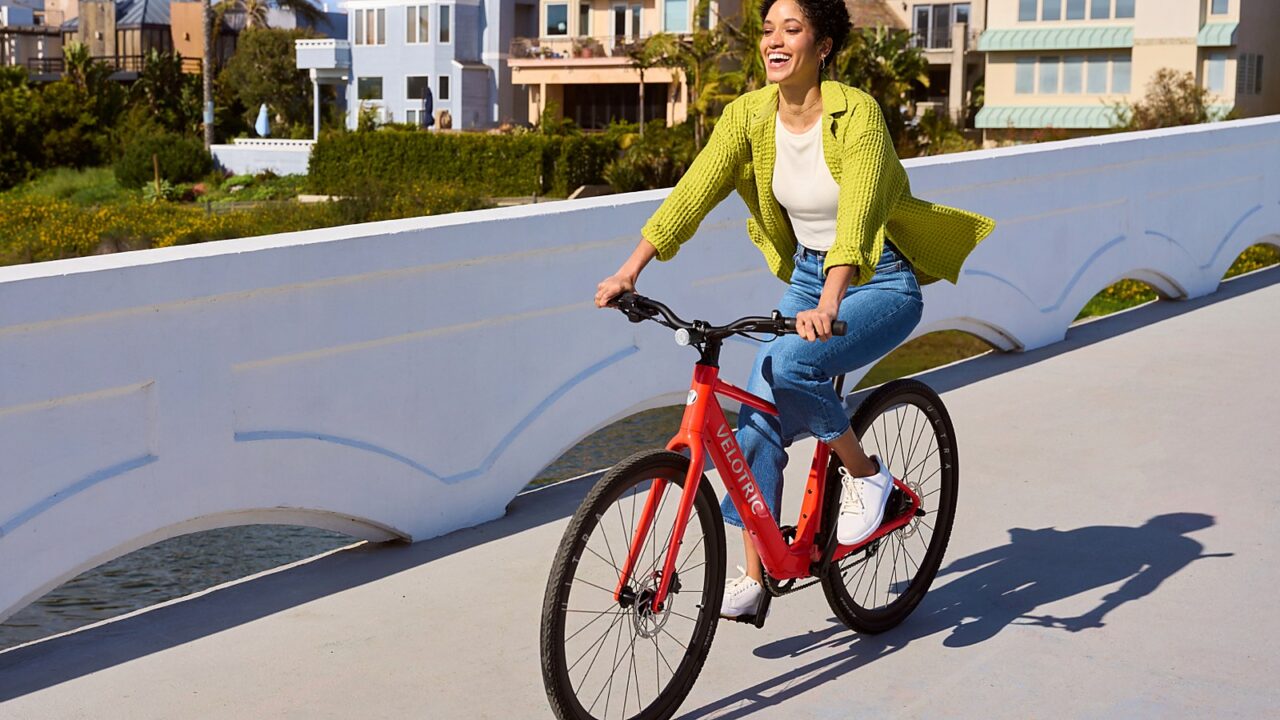
T1 ST Plus is Velotric's simple fitness-oriented city bike: 39 pounds, narrow 700c tires, rigid fork, torque sensor, integrated battery, and no throttle. It looks and pedals more like a regular bicycle than the brand's comfort commuters, which is exactly why some buyers want it and why others will be disappointed.
This review is based on official specifications and is not presented as a hands-on road test. The product feed showed $1,299 on August 19, 2026, while Velotric's comparison and campaign pages may reflect changing promotions.
The tradeoff map
Low weight, large batteries, comfort suspension, cargo capacity, and low price rarely appear together. A useful review names which advantages this bike prioritizes and what it leaves for another model.
In this guide
- A bicycle-first design
- Why 39 pounds matters
- Integrated battery: clean and limiting
- No throttle is a deliberate choice
- Range versus battery size
- Fit and high-step reality
- Rigid fork and urban surfaces
- Brakes, lights, and security
- T1 ST Plus versus Tempo
- The best and worst buyers
- Frequently asked questions
- Bottom line
Specifications that matter
| Item | Official specification or policy |
|---|---|
| Weight | 39 lb |
| Motor | 350W hub / torque sensor |
| Battery / range | 352.8Wh integrated / up to 70 miles |
| Fit | Regular 4'11-5'9; Large 5'6-6'4 |
| Key omission | No throttle; battery is not removable for charging |
Specifications and current configurations can be checked on Velotric T1 ST Plus official product page.

A bicycle-first design
T1 ST Plus avoids oversized tires, suspension, racks, and a large removable battery. The 700 x 40c tires and rigid frame aim for efficient city handling and useful pedaling even when assistance is low or off. Low-speed control, parking, and walking the bike often reveal more than a fast straight-line demonstration.
That makes sense for active riders and mixed indoor storage. It is less appropriate for someone who wants a soft cruiser, cargo platform, or motorbike-like throttle experience.
Why 39 pounds matters
The bike is materially easier to lift than Velotric's 60- to 80-pound models. Weight also affects acceleration under human power and how manageable the bike feels if the battery is depleted. Ask who will perform the first adjustment and where model-specific electrical support is available.
Still test the real staircase or wall rack. A long bicycle can be awkward even when its scale weight is reasonable, and owners should verify carrier capacity.

Integrated battery: clean and limiting
The 352.8Wh pack is built into the frame and is not intended for routine removal. That supports a slim appearance and reduces battery hardware, but the entire bike must reach an outlet for normal charging. Solve storage, charging, transport, and service before purchase because those constraints remain after the novelty fades.
Garage and ground-floor owners may never care. Apartment residents should solve outlet access before choosing T1 ST Plus over the removable-battery Tempo.
No throttle is a deliberate choice
T1 ST Plus uses a torque sensor and pedal assist without a throttle. Assistance responds to rider effort, keeping the experience closer to conventional cycling. The right model reduces friction in the most common trip instead of maximizing every possible specification.
A throttle can help some riders start under load or move through short difficult moments. Buyers who require that function should choose a different model rather than assuming it can be added later.

Range versus battery size
The up-to-70-mile claim is possible only under efficient conditions with meaningful rider contribution. A 352.8Wh battery contains less energy than larger Velotric packs, so high speed, hills, wind, and low pedaling effort have a larger proportional impact. Keep a reserve until several rides establish personal energy use; the display estimate is a planning aid, not a guarantee.
For a 10- to 20-mile daily route with charging access, the pack can be entirely practical. Long high-assist rides need conservative planning.
Fit and high-step reality
Regular and Large sizes cover a broad stated height range, but the frame is not a deep step-through. Stand-over height, reach, and the ability to swing a leg remain relevant. Small adjustments can refine a suitable frame, but they cannot rescue a frame whose basic saddle range or reach is wrong.
Riders with limited hip mobility should test mounting in everyday clothing. A low-step model may be worth extra weight if it makes every start safer.

Rigid fork and urban surfaces
The rigid aluminum fork keeps steering direct and weight down. Forty-millimeter tires add volume, but rough pavement will feel sharper than on Discover or Summit models. Low-speed control, parking, and walking the bike often reveal more than a fast straight-line demonstration.
Use appropriate tire pressure and avoid assuming maximum pressure is best. Riders on broken streets should compare Tempo's 42c tires or a suspended commuter.
Brakes, lights, and security
T1 ST Plus uses hydraulic disc brakes with 160mm rotors, a 120-lumen front light, rear light, app connection, and Apple Find My. It lacks the turn signals and brighter 500-lumen light found on Tempo. Practice in a low-risk area before adding speed, cargo, passengers, traffic, or uneven terrain.
Budget for visibility if riding dark roads. Tracking does not replace a lock, registration, and secure parking.

T1 ST Plus versus Tempo
Both weigh 39 pounds. Tempo adds a removable battery, throttle, 180mm rotors, brighter lighting, turn signals, NFC access, Apple and Android finding, wider tires, and multiple frame styles; T1 ST Plus is simpler and may cost less. Compare the complete setup, including accessories, assembly, locks, transport, and likely service rather than the bike price alone.
Choose T1 for active, uncluttered cycling and charging beside the bike. Choose Tempo for a more flexible city appliance with modern utility features.
The best and worst buyers
The best buyer enjoys pedaling, has indoor charging near the bike, values low weight, and does not need throttle or cargo equipment. The worst match expects plush suspension, heavy hauling, or effortless maximum-speed travel. A feature is worth paying for when it solves a repeated use case; an impressive specification with no regular job is just added cost.
The T1 concept is honest when evaluated on those terms. Problems begin when buyers compare only the 70-mile headline and ignore how the bike achieves it.

Choose the compromise consciously
Every design choice on Velotric T1 ST Plus buys one advantage by limiting another. Low weight usually means less battery, suspension, or cargo hardware; a large battery adds mass; wide tires add grip and drag. Write the central tradeoff beside the intended route. The model is a good match when its advantage is used frequently and its limitation appears rarely or can be solved without undermining the reason for buying it.
Test the bike with assistance low
A short ride in maximum assist can conceal gearing, fit, rolling resistance, and how the bike behaves near an empty battery. Use low assist, shift through the gears, and pedal briefly with power off in a safe area. This is especially important for riders who want exercise or need the bike to remain usable after a charging mistake. Smooth low-power behavior can be more valuable than dramatic acceleration.
Check charging before range
Locate the outlet, measure the cable route, and decide whether the battery or whole bike must move to charge. Confirm that the space is dry, open, and appropriate under the manual. A large range claim cannot solve an inconvenient or unsafe charging routine. For many apartment riders, removable battery access is a stronger daily feature than an additional theoretical ten miles.
Keep the upgrade path realistic
Do not assume a throttle, larger battery, different fork, rack, or security feature can be added later. Electrical compatibility, firmware, frame mounts, ratings, and warranty rules limit upgrades. Price the model that already contains required functions. Accessories should refine a suitable bike, not attempt to transform it into a different product category after purchase.
Know when simplicity wins
A simpler bike can be easier to carry, clean, maintain, and pedal without power. It may also have fewer features for comfort, weather, cargo, and security. Simplicity is valuable when the owner actually benefits from those reductions. It is false economy when required racks, lights, suspension, or battery access must be recreated through awkward add-ons.
Record the tradeoffs you accept
Before paying for Velotric T1 ST Plus, write a one-page decision that addresses a bicycle-first design, integrated battery: clean and limiting, range versus battery size, and rigid fork and urban surfaces. Use the rider's actual measurements, route, load, storage, charging location, and service access. A written record exposes contradictions that are easy to overlook while comparing colorful product pages. It also creates a useful list for a dealer or support representative, who can confirm whether the selected size, accessory, battery, and class configuration matches the intended use.
Save the current official page for Velotric T1 ST Plus, the cart showing included equipment, the return and warranty terms, and any written compatibility answer. Product bundles and prices can change between research and checkout. Confirm model year, frame, color, charger, battery, rack or passenger hardware, and delivery method on the final order. Do not rely on a review photograph to establish what comes in the box. If a feature is essential, it should appear in the current specification or in a direct written answer from the seller.
During the first month, revisit why 39 pounds matters, no throttle is a deliberate choice, fit and high-step reality, and t1 st plus versus tempo. Record tire pressure, assist mode, distance, battery use, weather, cargo, and any fit or brake adjustment. Small early corrections can improve comfort and reliability, while repeated problems may indicate that the model or setup is wrong. Keep packaging until the return window and condition are understood, register the bike promptly, and follow the manual's inspection schedule. This turns a buying guide into an ownership baseline instead of letting the research disappear after checkout.
Continue the buying research
Compare this decision with our range planning guide, the best affordable e-bike guide. These guides cover the route, fit, safety, and ownership questions that a single product page cannot settle.
Frequently asked questions
Does T1 ST Plus have a removable battery?
No. The battery is integrated; routine charging requires bringing the bike to an outlet.
Does it have a throttle?
No. It is a pedal-assist fitness e-bike with a torque sensor.
Can it reach 28 mph?
Velotric lists adjustable assistance up to 28 mph where Class 3 operation is legal.
Is T1 ST Plus the same as Tempo?
No. They share a 39-pound claim, but Tempo has a removable battery, throttle, more lighting and security features, and mid-step or high-step frames.
Bottom line
T1 ST Plus is for riders who want an e-bike to remain a bicycle. Its low weight, torque response, and simple road setup are more important than its lack of throttle or removable battery for the right owner. Tempo is the stronger alternative when charging flexibility and city equipment outweigh simplicity.
Check the current configuration before checkout
Visit the official Velotric T1 ST Plus page to confirm color, size, included accessories, shipping, and current price. Code REF601753 may provide $60 off when eligible; Velotric’s checkout and current terms are the final authority.
Before placing the order
Write down the actual weekly mileage, steepest grade, storage route, charging location, normal cargo, and service shop. Compare those facts with the model’s weight, battery, frame, brakes, and included equipment. This short exercise prevents a headline specification from outweighing the practical details that determine whether the bike is easy to use after delivery.
A sensible first-month plan
Begin in the lowest useful assist mode, confirm tire pressure and fasteners, practice braking and low-speed turns, and increase speed gradually. Recheck the manual after the first rides, schedule any recommended inspection, and record battery use on the real route. Personal data quickly becomes more useful than a generic range claim.
What a product page cannot decide
A manufacturer can publish dimensions, certifications, and component specifications, but it cannot know the rider’s balance, local traffic, stairs, weather, trail rules, or access to service. Those are not minor exceptions. They are part of the purchase and deserve the same attention as motor output and advertised range.