
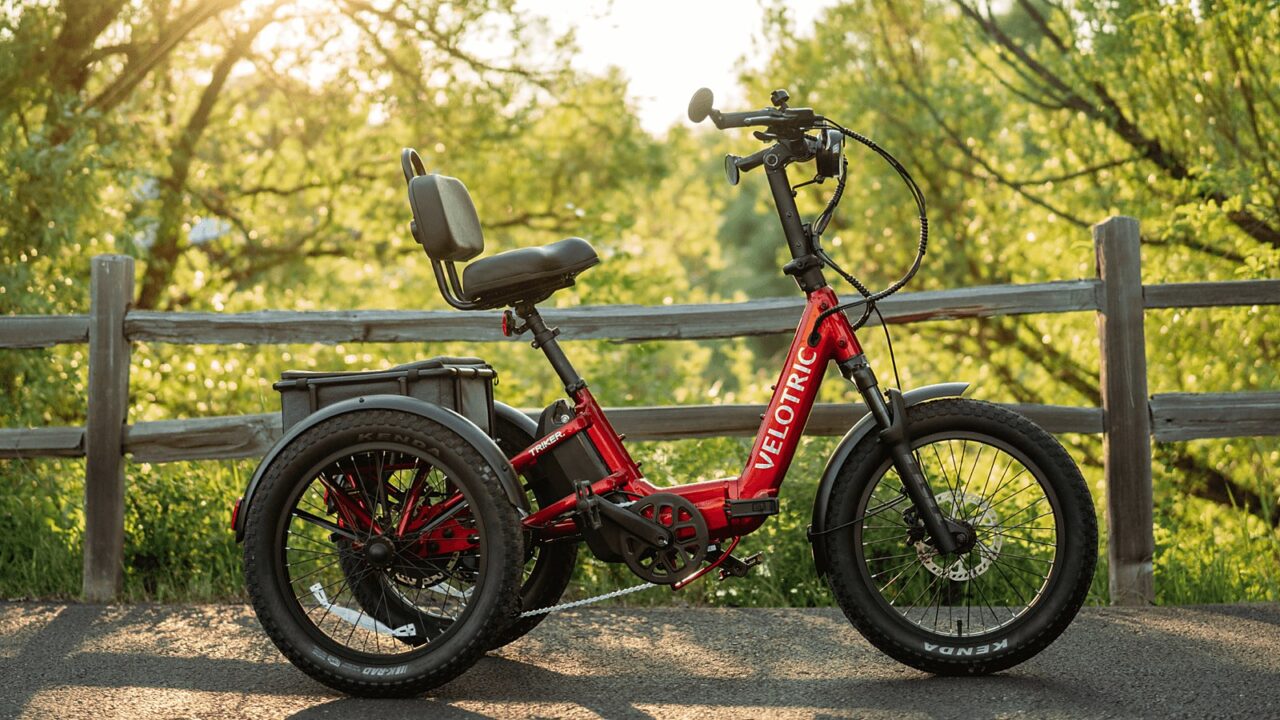
An electric tricycle can remove the need to balance at a stop, but it does not handle like a bicycle. Three wheels stay upright at rest while resisting the lean that helps a two-wheeler corner. That distinction should shape every Triker purchase decision before motor power, range, or cargo size enters the conversation.
This editorial review uses Velotric's current product specifications and safety features, not a claimed personal test. Velotric's product feed listed the Triker at $2,499 on August 19, 2026. Prospective buyers should arrange a dealer demonstration whenever possible.
The first purchase question is not how fast it goes. It is whether the rider can control, store, transport, and service it safely.
Specifications that matter
| Item | Official specification or policy |
|---|---|
| Top speed | 20 mph; Beginner Mode limits speed to 8 mph |
| Motor | 750W hub motor with differential rear axle |
| Weight / total load | 85.8 lb / 500 lb |
| Battery / range | 16.75Ah / up to 60 miles |
| Fit | 4'10 to 6'5; 370mm low step-through |
Specifications and current configurations can be checked on Velotric Triker official product page.

Stability at a stop is not cornering stability
Triker does not require the rider to put a foot down at every stop, which can help people who struggle with balancing a bicycle. In a turn, however, the trike stays upright while lateral force pushes rider and cargo outward. Published capacity is a ceiling under specified conditions, not a target for everyday use.
New owners should practice large slow turns in an empty level area, keep weight centered, and enter corners far below maximum speed. A trike can tip if turned sharply or driven with one wheel over a slope or curb.
Why a differential rear axle matters
A differential allows the two rear wheels to rotate at different speeds while turning. That is preferable to a simple one-wheel drive or locked axle because the outside wheel travels farther through a corner. Handling should be judged with the intended tire pressure, fit, and normal cargo rather than an empty display bike alone.
The hardware improves smoothness but does not cancel basic three-wheel physics. Test turns in both directions and learn how road crown and uneven pavement affect steering.

Beginner Mode is the right starting point
Velotric's Beginner Mode limits speed to 8 mph and uses three assist levels. Standard Mode can reach 20 mph, which is a significant speed on a wide, heavy tricycle. Published capacity is a ceiling under specified conditions, not a target for everyday use.
Use Beginner Mode until starts, stops, U-turns, reverse maneuvering, and emergency braking are repeatable. Speed should rise only after control is automatic.
Fit range and mounting
The 370mm low step-through and 180-degree rotating stem are intended to support riders from 4 feet 10 inches to 6 feet 5 inches. A 300mm saddle emphasizes support and upright comfort. Small adjustments can refine a suitable frame, but they cannot rescue a frame whose basic saddle range or reach is wrong.
A broad height range is not a guarantee for every body or mobility need. Verify knee extension, reach, hip clearance, hand strength, and the ability to look behind while steering.

Eighty-five pounds changes ownership
At 85.8 pounds, Triker is heavier than many two-wheel e-bikes, and its rear track is much wider. Carrying it upstairs or using a standard bicycle rack is generally unrealistic. Solve storage, charging, transport, and service before purchase because those constraints remain after the novelty fades.
Measure every doorway, gate, storage path, vehicle ramp, and final parking space. Plan how a flat tire or depleted battery will be handled away from home.
Cargo capacity and basket loading
The official maximum total load is 500 pounds, including rider and basket contents. A large rear basket invites bulky shopping and pets, but high or uneven cargo can affect cornering. Practice in a low-risk area before adding speed, cargo, passengers, traffic, or uneven terrain.
Place dense items low and centered, secure everything, and remain below both total and basket-specific limits. Introduce live animals only with appropriate restraint and gradual training.

Motor, hills, and rollback
The 750W motor and differential drive are designed to move the trike under load. Hill ability depends on grade, combined weight, battery charge, and traction, while descending places greater demand on brakes. The useful question is how often that condition appears, not whether the bike can encounter it once.
A prospective owner with steep streets should test the actual area with a dealer. Avoid side slopes, approach driveways squarely, and never assume motor power guarantees a safe descent.
Brakes, parking, and visibility
Triker lists hydraulic braking, an automatic parking lock, a 400-lumen headlight, turn signals, and a 100dB horn. The parking feature is important because a trike cannot be stabilized by a bicycle kickstand in the usual way. Practice in a low-risk area before adding speed, cargo, passengers, traffic, or uneven terrain.
Confirm the parking brake is fully engaged before mounting, loading, or leaving the trike. Integrated signals supplement but do not replace conspicuous positioning and visual checks.

Range planning for a heavy platform
Velotric advertises up to 60 miles, but an 85.8-pound trike carrying a rider and cargo can consume energy quickly at high assist or on hills. A dead battery still leaves a heavy vehicle to pedal or move. Keep a reserve until several rides establish personal energy use; the display estimate is a planning aid, not a guarantee.
Use conservative turnaround points and charge before the display reaches an emergency level. Riders with limited pedaling capacity should preserve a larger reserve.
Dealer support matters more for a trike
Assembly, alignment, brake adjustment, and transport are more involved than on a simple city bike. A nearby dealer can also help teach controls and verify that the trike fits the intended storage and mobility context. Ask who will perform the first adjustment and where model-specific electrical support is available.
Buying online may still work, but price professional assembly and identify a service provider before delivery. The cheapest checkout is not the cheapest ownership path if the trike cannot be moved for service.

Plan the learning environment
The first rides on Velotric Triker should happen in a level, open area without traffic, passengers, pets, or loose cargo. Practice power-on starts, smooth braking, tight turns, and dismounting before increasing assist. Repeat with the motor off so the rider understands weight and steering without power. Training should reflect the specific platform rather than relying on experience with a different bicycle or mobility device.
Separate capability from permission
A speed setting, throttle, payload number, or trail-oriented feature describes what hardware can do under stated conditions. It does not establish legality or access. State laws, local ordinances, trail managers, property owners, passenger rules, and equipment requirements can impose narrower limits. Verify the exact route and use case. Keeping the bike in a lower class setting may be necessary even when the display allows another option.
Create an emergency plan
Decide what happens after a flat tire, depleted battery, warning code, fall, or sudden weather change. Heavy and wide e-bikes may not fit a normal vehicle or transit rack. Keep support numbers, identification, a charged phone, and a realistic pickup method available. The farther the route moves from home or pavement, the more conservative the battery reserve and mechanical preparation should become.
Inspect the points that carry load
Before each loaded ride, check tire pressure and damage, wheel attachment, brake lever feel, rack and accessory fasteners, battery retention, and anything that could enter a wheel. Recheck after the first rides because new hardware can settle. When a passenger or pet is involved, inspect restraints and guards separately. A high published capacity cannot compensate for a loose fastener or poorly distributed load.
Use speed as a trained skill
Higher assisted speed reduces reaction time and increases stopping distance and cornering forces. Begin below the platform's maximum even when local law allows more. Add speed only after emergency braking, shoulder checks, lane positioning, and low-speed control are reliable. Comfort at a display number is not the same as control when a car door opens, pavement changes, or cargo shifts.
Document the safe-use plan
Before paying for Velotric Triker, write a one-page decision that addresses stability at a stop is not cornering stability, beginner mode is the right starting point, eighty-five pounds changes ownership, and motor, hills, and rollback. Use the rider's actual measurements, route, load, storage, charging location, and service access. A written record exposes contradictions that are easy to overlook while comparing colorful product pages. It also creates a useful list for a dealer or support representative, who can confirm whether the selected size, accessory, battery, and class configuration matches the intended use.
Save the current official page for Velotric Triker, the cart showing included equipment, the return and warranty terms, and any written compatibility answer. Product bundles and prices can change between research and checkout. Confirm model year, frame, color, charger, battery, rack or passenger hardware, and delivery method on the final order. Do not rely on a review photograph to establish what comes in the box. If a feature is essential, it should appear in the current specification or in a direct written answer from the seller.
During the first month, revisit why a differential rear axle matters, fit range and mounting, cargo capacity and basket loading, and range planning for a heavy platform. Record tire pressure, assist mode, distance, battery use, weather, cargo, and any fit or brake adjustment. Small early corrections can improve comfort and reliability, while repeated problems may indicate that the model or setup is wrong. Keep packaging until the return window and condition are understood, register the bike promptly, and follow the manual's inspection schedule. This turns a buying guide into an ownership baseline instead of letting the research disappear after checkout.
Continue the buying research
Compare this decision with our e-bike safety guide, the guide to e-bikes for seniors. These guides cover the route, fit, safety, and ownership questions that a single product page cannot settle.
Frequently asked questions
Is a trike automatically safer than a bike?
No. It removes balancing at stops but has different cornering and side-slope risks. Training and low-speed practice are essential.
Can Triker be transported on a normal bike rack?
Most standard racks are unsuitable because of weight and width. Use equipment specifically rated for the trike's dimensions and load.
Is Triker only for seniors?
No. It can suit any adult who values stop stability and cargo capacity, provided the rider can safely steer, brake, and judge width.
Can it go 28 mph?
The current official maximum is 20 mph, with an 8 mph Beginner Mode.
Bottom line
Triker should be purchased after a real three-wheel test ride, not because it appears impossible to tip in product photos. Its low step-through, differential, Beginner Mode, parking lock, and large capacity address genuine needs. The owner must still learn slow cornering, solve storage and transport, and plan service before delivery.
Check the current configuration before checkout
Visit the official Velotric Triker page to confirm color, size, included accessories, shipping, and current price. Code REF601753 may provide $60 off when eligible; Velotric’s checkout and current terms are the final authority.
Before placing the order
Write down the actual weekly mileage, steepest grade, storage route, charging location, normal cargo, and service shop. Compare those facts with the model’s weight, battery, frame, brakes, and included equipment. This short exercise prevents a headline specification from outweighing the practical details that determine whether the bike is easy to use after delivery.
A sensible first-month plan
Begin in the lowest useful assist mode, confirm tire pressure and fasteners, practice braking and low-speed turns, and increase speed gradually. Recheck the manual after the first rides, schedule any recommended inspection, and record battery use on the real route. Personal data quickly becomes more useful than a generic range claim.
What a product page cannot decide
A manufacturer can publish dimensions, certifications, and component specifications, but it cannot know the rider’s balance, local traffic, stairs, weather, trail rules, or access to service. Those are not minor exceptions. They are part of the purchase and deserve the same attention as motor output and advertised range.